
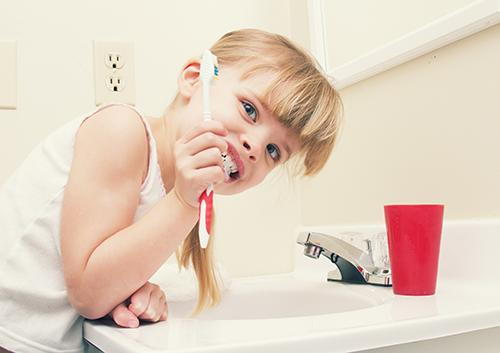
You’re all set for your happy morning and nighttime ritual. You’ve provided your son with his favorite action hero toothbrush and your daughter with her favorite flavored toothpaste. You’ve gotten them into the healthy habit of two minutes of brushing twice each day. You’ve introduced them to flossing. You have your favorite brushing songs! Stickers! Gold stars! And, best of all, you’re teaching great brushing techniques.
Kids need the same basic brushing tools and skills as adults. What makes for the best cleaning?
Find the right brush
No matter how cute—or heroic- the brush needs soft bristles to protect enamel and delicate gum tissue. The head should be a perfect fit for your child’s mouth. And if the handle is easy to grip and hold, you have a winner.
Find the right toothpaste
The bubblegum flavor might appeal to your child, but the fluoride helps prevent cavities. Talk to us about when to start using fluoride toothpaste and the right amount for your child’s brush.
Teach your child the angles
Start geometry lessons early if your child is too young to brush alone. Holding the brush at a 45-degree angle toward the gums will clean bacteria and plaque from the tooth surface and the gum line. And don’t forget the chewing surfaces and the insides of the teeth. When your child begins brushing on her own, coach her as she learns the best way to clean all the surfaces of her teeth.
Easy does it
Teeth and gums should be massaged, not scrubbed. Brushing too hard can damage tender gum tissue and your child’s enamel.
Learn to let go
No matter how comfortable and appealing the brush, it’s time for a change after three or four months. Frayed bristles don’t clean as effectively, and making up for it by brushing harder isn’t the answer (see above). Also, toothbrushes can build up quite a collection of bacteria over time (see below), so a fresh brush is a must!
Everything in its place
A toothbrush should dry thoroughly between uses without touching other brushes. Placing a brush in a plastic container prevents it from drying and encourages bacterial growth. A toothbrush needs its own space—touching toothbrush heads means sharing toothbrush bacteria. The best way to keep toothbrushes as dry and as germ-free as possible is to store them upright, without touching other brushes, in a clean, well-ventilated area.
Rinse and repeat
Your child should rinse his toothbrush before and after using it, and he should be sure to rinse his mouth as well. This should get rid of any leftover food particles the brushing has removed.
Finally, keep up the good work! By teaching your child proper brushing techniques and ensuring she uses them as she grows, you prepare her for a lifetime of great checkups with the dentist at our Port Washington, NY, office. If you need to book an appointment for a regular check-up or a follow-up after an emergency, do so as soon as possible.